


Today, orthopedists very often diagnose straight valgus feet in children.This deformity consists of sinking of the inner part of the foot.That is, the straight line from the lower leg to the lower leg is curved.Visually, you can also see that the height of the outer arches of the foot decreases.The inner longitudinal arch of the foot disappears.A characteristic feature of planovalgus foot deformity in children is that the feet are in the shape of the letter "X".This will be obvious if the child stands up straight.
Valgus flat feet can rarely be congenital, but more often it is a deformity that develops in children under 3 years of age.This position of the foot is noticeable when the baby takes its first steps.At this stage, parents should react and show the child to an orthopedist.
Forms
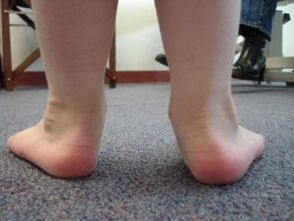
Valgus flat feet can be of two forms: congenital and acquired.Congenital deformity is diagnosed by doctors already in the first month of life.This disorder develops during intrauterine development.Often this happens due to a genetic predisposition.
Congenital plano-valgus deformity can occur in very severe forms.For example, these are the rocker leg and vertical ram.Rocker's foot most often develops in babies with Edwards syndrome.Vertical talus is a complex foot injury because its treatment requires surgery.Often these include grafting, lengthening or adjusting the scaphoid bone, etc.in the form of operations on tendons.But sometimes they are done only with plaster casting.
With the obtained form of deformation, the structure of the leg changes under the influence of various factors.This is usually a weak and not yet perfect tendon-ligament apparatus, etc.
Reasons
The main cause of valgus flat feet in children is the weakness of the muscle-aponeurosis of the foot.And after a year, since the load on the child's musculoskeletal system is quite large, the legs begin to bend and the legs sink inward.Accordingly, all arches and arches of the foot develop incorrectly.
Factors that trigger valgus flat feet include:
- rickets With this disease, the bone tissue becomes fragile and deformed;
- muscle paralysis.This may be after poliomyelitis;
- accompanied by other serious diseases - cerebral palsy (CP), polyneuropathy, muscular dystrophy;
- chronic disease of an infectious or viral nature contributing to circulatory problems;
- traumatic injuries of the foot and leg;
- various dysfunctions of the endocrine system.For example, overweight or underweight, diabetes, etc.
- lack of nutrition, poor diet, lack of vitamins and minerals in the body.
Doctors note that hallux valgus can develop due to improperly selected shoes for a child.It is contraindicated to wear shoes with flat, soft soles, hard back and no foot support.Especially for children under 3-5 years old.
The risk group also includes children who lead a sedentary lifestyle when the child does not do any physical exercise.
Congenital flat-valgus feet are often seen in premature babies and when the child is underweight in the womb.
Signs and symptoms
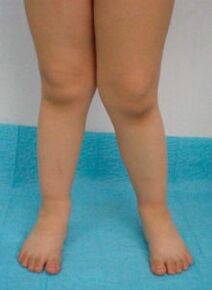
Visible signs of this foot deformity in a child:
- Changes in mileage.The child walks clumsily, shuffles his feet, and his steps are unstable.
- When walking, it mainly steps on the inside of the foot.
- In children, poor posture and bent back are always accompanied by foot deformities.
- The leg is shapeless and compressed.In children, the legs appear plump.
- X-shaped legs.
Parents may also notice other symptoms in their child:
- tired legs and pain at the end of the day;
- headache;
- back pain.
Damage rate
There are 4 main stages of planovalgus foot deformity.At the initial stage, the curvature is not more than 150.Many children have this disorder, but if parents notice the problem in time, it can be corrected very easily and quickly.
In the second stage, the curvature of the leg reaches 200.This degree of damage requires longer treatment, but gives a positive result.
In the third stage, flat-valgus feet in children need to be treated comprehensively, and the treatment will be long-term.At this stage, the heel deviates 300.The fourth stage is diagnosed when the curvature is more than 300.This deformity can only be corrected surgically by qualified specialists.
Diagnostics
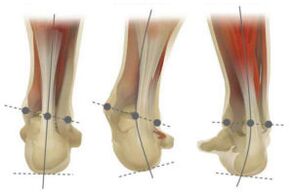
The diagnostic process begins with a visual examination of the child by an orthopedic doctor.Then, the child is sent to other studies to determine the degree of deformation of the child's leg.Among them:
- X-ray - this study helps the doctor to accurately determine the presence of hallux valgus and its degree of development.For this, the picture is taken in three projections.
- Podometry is a computer diagnostic used when a deformity is suspected when it is difficult to diagnose visually.That is, the signs are not expressed.
- In children, an ultrasound examination is performed to understand the condition of the joints and the presence of other concomitant diseases.
- Computer planography is a work in which the feet are scanned on a special platform.The computer can determine various morphological parameters.In this case, the doctor will understand how the load on the leg is distributed.Plantography can also be done with stress tests.
The orthopedist will send the little patient for a consultation with a neurologist to accurately determine whether there are diseases of the central nervous system.Other specialists that should be visited are a surgeon and an endocrinologist.
Treatment
Treatment of straight-valgus legs in children is necessary at any stage of the deformity.It depends on the extent of the damage.The main goal of therapy is to restore the normal condition of the foot.At the first stage, it will be enough for the child to wear proper orthopedic shoes and do physical exercises.There are special foot exercises that parents can playfully perform with their child to treat them.Sometimes a course of therapeutic massage is prescribed at this stage.Such treatments help strengthen muscles and ligaments locally.
Conservative treatment for other stages of flat-valgus foot in children consists of paraffin therapy, therapeutic massage and gymnastics.They also use physiotherapy in the form of electrophoresis, magnetic or electrical muscle stimulation.
Paraffin therapy is performed in children's clinics.Paraffin bandages are carried over the entire leg and stretch up the calf like a high boot.After this procedure, you can start the massage.This will be quite effective, because the muscles soften after paraffin.
If a child has hallux valgus, then therapeutic massage should be performed only by a qualified specialist.You can do it at home if a specialist has given permission and instructed your parents.
Surgical treatment

If all methods of conservative treatment do not work or if the stage at which the parents consult a doctor progresses, surgical treatment is used.
Treatment of planovalgus foot deformity can be done by Dobbs method.This includes hand shaping the legs and plaster casting.Approximately 6 procedures are required, which are carried out at intervals of one week.After each week, the position of the foot changes during casting.The cast starts from the middle of the thigh, the leg is bent at the knee.At the end of this stage of treatment for straight valgus feet, the doctor must adjust the talonavicular joint in the correct position.For fixation, the doctor installs a Kirschner wire inserted through the skin.The cast should fix the leg in about 2 months.After that, a plaster cast in the form of a boot is applied.Next, overfitting is recommended, that is, special shoes with the desired shape.The child should wear them constantly, and only after a while should they be put to sleep during the day and at night.
Plano-valgus foot deformity can also be corrected using minimally invasive surgeries.This changes the angle between the bones and consequently increases the tension of the ligaments.
For children, arthrodesis-type operations are used very rarely, because it results in a high level of trauma and is followed by pain when walking.During hallux valgus surgery in children, doctors create a stable connection between the talus and the calcaneus, thereby strengthening the muscles of the inner arch.
Results
Timely diagnosis of hallux valgus is very important, because as the disease progresses, the musculoskeletal system will be affected more and more.It is fraught with the appearance of clubfoot, scoliosis and flat feet.This is a condition for the appearance of arthrosis, arthritis, cervical spine diseases and constant pain in the legs.
Prevention
To maintain the therapeutic effect of the therapy, the child should wear special orthopedic shoes.All shoes should reach calf level and have rigid back support.Either sandals or boots.
For plano-valgus feet, you need to buy an insole that can be inserted into any shoe.But on condition that these are high shoes.
It is very important for the child to do gymnastics for his legs, in addition to doing daily exercises and leading an active lifestyle.Prescribed by a doctor, but the simplest exercises:
- inside and outside the foot, walking on the heel;
- pumping a rolling pin or other round object with your feet;
- picking up objects and drawing with toes;
- perform leg rotations.